
Today, almost everything we touch is powered by AI in some way, and procurement professionals who do not learn to use it risk being left behind. Negotiation is no exception. Using AI in negotiations is playing an ever-increasing role, with new digital tools and platforms emerging at remarkable pace. And yet, alongside the genuine progress, there is also a swirl of hype that we all need to navigate carefully.
Deloitte’s 2025 Global Chief Procurement Officer Survey found that the most advanced procurement organizations are now allocating up to 24% of their budgets to procurement tech, nearly double the figure reported in 2023, with Generative and Agentic AI driving much of that growth (Deloitte, 2025). Gartner (2025) has gone further, predicting that by 2028 more than 95% of enterprises will have used GenAI APIs or deployed GenAI-enabled applications in production. So CPOs are no longer asking whether to invest in AI – they are deciding how, where, and how quickly.
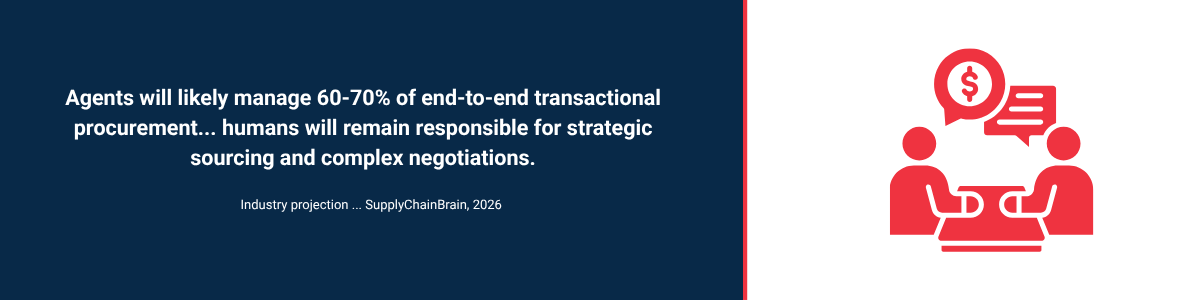
I want to start by addressing the boldest claim of all… that AI will soon replace the human negotiator. It is a claim made most loudly, in my experience, by the very same people selling a new piece of AI-powered tech. It is also wrong. Or at least, it is wrong in the way it’s usually framed.
The end of the human negotiator?
Let me push back on the prediction. In general, AI in negotiation will not replace humans. It will not steal the role of the procurement professional, the Head of Procurement, or anyone else who currently sits at the table on behalf of an organization.
To understand why, it helps to recognize that negotiation covers a huge range of interactions in pursuit of some form of agreement. At one end are simple, transactional exchanges. At the other end are complex, multi-negotiable, multi-party engagements with significant dependencies and a high risk of personal and corporate loss if we fall short. Beyond the very basic interactions, negotiation has multiple human dynamics serving human interests. So long as we remain vested in the outcome, we will need to be in the loop.
AI is already aiding human negotiations in many ways, but it does so as part of the team, rather than replacing it. This shift in mindset is key to understanding where AI in negotiation can genuinely help, and it removes the natural fear that many people feel when they hear the more aggressive predictions about an AI negotiation platform replacing the buyer.
Why AI seems perfect for negotiation, in theory
Negotiation is the convergence of personality, process and repertoire, and a good performance is a complex combination of learnt styles and responses across all three. With the right inputs, the right prompts, and clarity around the outputs needed, AI is genuinely good at learning, which gives it a natural ability for negotiation.
AI also has no inherent personality traits that might hinder its performance. It carries no biases unless it has been taught to do so. It can even adopt a particular personality in the way it outputs or communicates. In theory, AI can be the perfect negotiator. In practice, it has a long way to go.
What AI actually is
Despite its name, AI is not really intelligent. It is, instead, a complex and ever-evolving set of learnt responses to the inputs it is provided with. AI’s apparent intelligence at its foundation level is built upon the Boolean principles of ‘if this, then that.’ However, it moves beyond this using probabilistic algorithms and neural networks that allow it to learn patterns from massive data sets and make predictions based on probability.
This is best explained through a variation on the Chinese room analogy, first presented by John Searle in 1980 (Searle, 1980). Imagine a man sitting in a closed room. The man knows no Chinese. On the table in front of him is a book full of Chinese characters or group of characters. Beside each is another corresponding character or group. A piece of paper is pushed under the door, containing a series of Chinese characters. The man looks at each, locates them in the book, then writes the corresponding character or group on the piece of paper. When he is finished, he pushes the completed paper back under the door.
Using the book and the ‘if this, then that’ principle, the man communicates perfectly in Chinese. He does not understand a single word of what is being said, and he is not thinking about the message in any meaningful way; he is simply following the instructions in the book.
The ability of AI to apparently think for itself is therefore entirely dependent upon the inputs it is given and how it has been trained. In other words, how extensive and up to date the book of “if this, then that” is that sits in front of the man. As we move ever closer to agentic AI, and ultimately Artificial General Intelligence (AGI), it will start to seem as though AI is thinking for itself with cognitive ability similar to humans. But it will not be. The books will simply be thicker, the volumes more numerous, and the operations carried out far faster.
Good negotiation for complex scenarios requires a high level of intelligence that goes well beyond “if this, then that”. Much of what we do in a negotiation happens at a subconscious level, especially when we are reading body language or picking up subtle cues in spoken language. This is where humans excel, for the time being at least. And ultimately, securing the best outcome comes down to what power we have and how we use it. AI cannot change what each party’s position is, or what outcomes are desired. But it can help us understand power, plan more thoroughly, and even support some elements of the negotiation itself.
The Five Watch Outs When Applying AI in Negotiation
Having AI on the team can be transformative, but before rushing off to put everything into your preferred AI tool, or the latest AI negotiation platform, there are some big watchouts. I want to walk through five of them, because each one has the potential to derail an otherwise well-planned approach.
1. Data security risk
If we are using an open AI GPT (such as ChatGPT), we have to remember that it learns from everything it is fed. Despite the reassurances we are given, an open large language model (LLM) will absorb commercially sensitive information, supplier data, and anything specific to our negotiation scenario, and apply that learning to future queries… which could just as easily come from our opponent or others. The risk to competitive advantage is significant, and once the data is in, it is very hard to get out.
The cautionary tale most often cited here is Samsung. In April 2023, the company discovered that engineers in its semiconductor division had pasted proprietary source code, defect detection algorithms, and confidential meeting transcripts into ChatGPT on three separate occasions in less than twenty days (Gurman, 2023; Maddison, 2023). Samsung subsequently banned the use of generative AI tools on all company devices, but the data had already left the building. It could not be recalled, deleted, or unlearned.
The risk is heavily reduced when we use closed AI, sometimes described as a walled-gardened environment, which sits safely within our own organization or within the controlled limits of a software provider’s application. The trade-off is that what closed AI has been trained on may be narrower in scope. Most organizations now have strict policies on this. So before embarking on using an AI tool to support negotiation, verify the data security position. The simple rule to remember here is… before entering anything into an AI tool, be certain the data remains secure.
2. AI hallucinations and basic errors
Just because AI produces an output, it does not mean that the output is good or robust. AI will do precisely what it has been trained to do and follow prompts literally, without the sense check that a human would naturally apply. It will quickly expose weaknesses in how we prompt it, and it will sometimes return incorrect or misleading results. Sometimes the results can be extreme and crazy. These are AI hallucinations, and they can represent “AI gone wrong.” They can also occasionally be the source of great creativity.
This is not a small problem. A series of studies by Stanford University researchers found that general-purpose LLMs produced hallucinations in 58% to 88% of their responses to specific legal queries, and even specialized AI tools designed for the same task hallucinated more than 17% of the time (Stanford Institute for Human-Centered AI, 2024). The point is not that AI is hopelessly unreliable. It is that we cannot assume any output is correct until we have checked it ourselves, and the more important the negotiation, the harder we should check.
Equally, even well-trained negotiation bots can make basic errors that an experienced human would never make. In early experiments where AI bots have been put head-to-head against each other in negotiation simulations, some have committed the cardinal negotiation error of revealing their bottom line when politely asked for it. No human negotiator with even modest training would do this, yet a bot will, because it is trying to be helpful and to respond literally to the prompt. The lesson here is to validate and sense check what it produces. In negotiation this means that we need to validate and apply the human check to any strategies or suggested courses of action before charging off to act on it.
3. Ethical use of negotiation data
It doesn’t take much for something that seems acceptable today to drift into territory that is ethically questionable tomorrow, and, we must be careful not to be caught out. If we are using AI to analyze supplier data, suppliers should know, may need to give consent, and may need to be afforded the option to opt-out.
There is a deeper issue too. Research from the University of Southern California (Gratch and Fast, 2022) has indicated that when we delegate our negotiations to an AI agent, we tend to condone less ethical behaviour from that agent than we would tolerate in ourselves. Something about working through an intermediary creates a sense of moral distance. This is the same effect that has long been observed when people negotiate through human agents, but with AI it can be amplified, because we are even less in the room than we were before.
If left unchecked, AI could push past boundaries it has no awareness of in pursuit of the goals we have set it. It might suggest strategies that do not respect fair competition or direct us to exploit a supplier’s accurately detected breaking point in ways we would, on reflection, consider unfair. With the great power AI brings to a negotiation comes great responsibility to consider privacy, fairness, transparency, and above all to maintain human oversight at every stage. Guard rails and understanding when humans should be fully ‘in the loop’ as well as when just ‘on the loop’ become of paramount importance.
4. Preventing AI bias
We have seen how AI in negotiation can help us overcome our own human biases, but AI can also introduce new biases of its own, which can catch us out because we are not aware it is happening. AI bias occurs if there is bias in the training data used to build the AI model, if the algorithms have been designed to favour certain outcomes (e.g. cost savings over sustainability), or if there is bias hidden in any sentiment or emotion analysis. Bias can also occur if the AI has been trained on historical data sets that do not reflect a balanced distribution of gender, demographic, or cultural background.
Because AI learns from previous interactions, any AI bias is quickly amplified. The way to prevent this is through the use of diverse and representative training data, and by maintaining a robust human check on what AI produces.
5. Loss of negotiation voice
This is the watchout I have been thinking about most recently, and in many ways, it is the one that concerns me most, because it is the easiest to miss. As more and more procurement teams use AI to draft emails, prepare positions, write counter-offers and even shape verbal scripts for online negotiation sessions, our communication is starting to take on a uniform quality.
LLMs are trained on the most dominant patterns of language, and as they become more embedded in our daily work, they tend to erase the demographic, cultural and personality differences that make our communication distinctive. The unique psychological signature that each of us brings to a negotiation, our particular phrasing, our cadence, the small turns of phrase that build rapport with a specific supplier, all of this risks being smoothed away.
The result can be conversations and negotiations that are blander, less creative, and less productive. Worse still, two parties who are both running their words through similar AI tools may end up sounding remarkably alike, removing the very texture that builds connection and trust. In a digital negotiation, where we are already working harder to communicate without the full benefit of body language, this matters even more.
The defense here is conscious practice. Use AI as a co-pilot, not a ghost-writer. Let it sharpen your thinking but keep your voice your own.
Where this leaves us
So if AI in negotiation is not going to replace the human negotiator, and if there are this many watchouts to navigate, what is the right way forward?
The answer, in a phrase, is symbiotic intelligence. AI as part of the team. AI as a co-pilot. Human intelligence combined with AI in negotiation, supporting us in real-time, doing the heavy lifting on data and preparation, and freeing the human to do what humans do best... read the room, build the relationship, exercise judgement, and close the deal.
This is the part of AI in negotiation that gets genuinely exciting, and it is also where most procurement organizations are now actively investing. Whether through AI-powered planning tools, intelligence and analytics platforms, roleplay and practice tools, or a full AI negotiation platform built specifically for our discipline, the opportunities are growing every month. In Part 2 of this Insight series, I will walk through the four practical ways AI is powering negotiation in procurement today, and explore where you should focus to harness it effectively, both online and face-to-face.
For now, though, the message is simple. Treat AI in negotiation as a powerful new member of the team. Train it well, oversee it carefully, and never stop being the one who decides.
If you want to take this further, we explore exactly how to build AI into a winning negotiation approach across our negotiation training programs, from Introduction through to Advanced, as well as in our Red Sheet® methodology and Ruby – the guided negotiation plan creator®.
This article has been adapted from Negotiation for Procurement and Supply Chain Professionals by Jonathan O’Brien (published by Kogan Page).
Jonathan O’Brien, CEO of Positive Purchasing Ltd., is a leading expert on negotiation and works with global blue-chip organizations to help transform their negotiation and procurement capability. He helped pioneer the Red Sheet® negotiation methodology and Ruby, the AI-powered guided negotiation plan creator®.
References:
Stanford Institute for Human-Centered AI (2024) Hallucinating law: legal mistakes with large language models are pervasive. Available at: https://hai.stanford.edu/news/hallucinating-law-legal-mistakes-large-language-models-are-pervasive (Accessed: 11 May 2026).
Deloitte (2025) Procurement at the tipping point: Deloitte's 2025 Chief Procurement Officer Survey reveals the pressure and promise of technology disruption. Available at: https://www.deloitte.com/us/en/about/press-room/2025-chief-procurement-officer-survey.html (Accessed: 14 May 2026).
Gartner (2025) Hype Cycle for Generative AI, 2025. Available at: https://www.gartner.com/en/articles/hype-cycle-for-genai (Accessed: 14 May 2026).
Gratch, J. and Fast, N.J. (2022) 'The power to harm: AI assistants pave the way to unethical behavior', Current Opinion in Psychology, 47, 101382.
Gurman, M. (2023) Samsung bans generative AI use by staff after ChatGPT data leak. Available at: https://www.bloomberg.com/news/articles/2023-05-02/samsung-bans-chatgpt-and-other-generative-ai-use-by-staff-after-leak (Accessed: 13 May 2026).
Maddison, L. (2023) Samsung workers made a major error by using ChatGPT. Available at: https://www.techradar.com/news/samsung-workers-leaked-company-secrets-by-using-chatgpt (Accessed: 14 May 2026).
Searle, J.R. (1980) 'Minds, brains, and programs', Behavioral and Brain Sciences, 3(3), pp. 417-424.